
Symbology of the past … or the present as well? - lower part of the clock
Compared to the mystical decorative symbols around the astrolabe, the area around the calendarium appears to be an idyllic tranquility.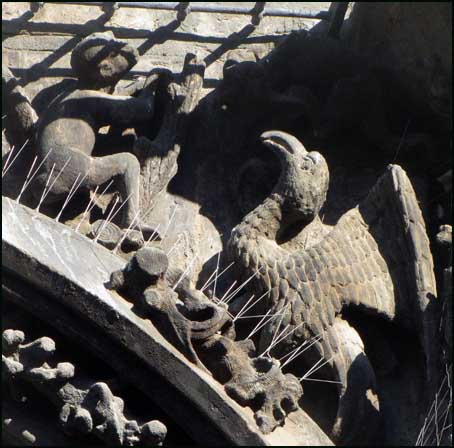 It is strictly separated – not only
visually by the clockmaker’s bridge. It is full of vegetative symbols
and symbols of life. Grapevine encircles the entire circle of the
calendar dial. As early as in the times of Sumerians, wine was
considered a divine drink, which liberates from mundane concerns and
brings joy, youth and eternal life.
It is strictly separated – not only
visually by the clockmaker’s bridge. It is full of vegetative symbols
and symbols of life. Grapevine encircles the entire circle of the
calendar dial. As early as in the times of Sumerians, wine was
considered a divine drink, which liberates from mundane concerns and
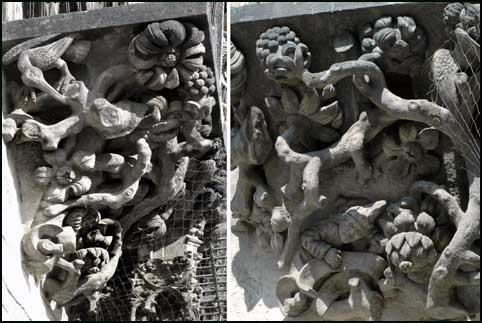
brings joy, youth and eternal life. 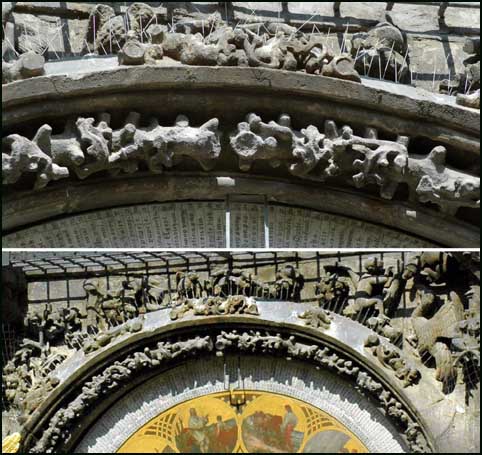 The antique cult
of Dionysius (or else Bacchus) can serve as an example. Thank God that
this has not changed in our region up to present days. Right beneath
the bridge, in the branches, there are a monkey and a bird with a long
neck and its wings wide spread. The bird could be a phoenix, a fiery
bird, a symbol of eternity, a cycle of resumption and resurrection. It
was worshipped by all ancient civilizations. Phoenix perishes in flames
and burns down but a new bird is reborn from the ashes in a short while.
The length of its life can differ from five hundred to 26 thousand
years, which is the interval of the Great Year. After this period,
astronomical objects return to their initial positions due to
precession of the Earth’s axis. Sitting in stone branches, the phoenix
seems to be debating with the monkey. In ancient times, monkeys were
domestic animals, docile and skilful. In the Middle Ages, however, it
became a symbol of peccability, cupidity and incarnation of devil.
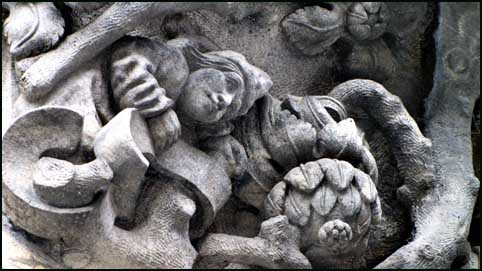
Vegetative motives continue beneath the entrance to the bridge as well
as around the door; they are unusually tangled and vivid. In the
branches, among leaves and fruits, we can recognize birds with a forest spirit.
The antique cult
of Dionysius (or else Bacchus) can serve as an example. Thank God that
this has not changed in our region up to present days. Right beneath
the bridge, in the branches, there are a monkey and a bird with a long
neck and its wings wide spread. The bird could be a phoenix, a fiery
bird, a symbol of eternity, a cycle of resumption and resurrection. It
was worshipped by all ancient civilizations. Phoenix perishes in flames
and burns down but a new bird is reborn from the ashes in a short while.
The length of its life can differ from five hundred to 26 thousand
years, which is the interval of the Great Year. After this period,
astronomical objects return to their initial positions due to
precession of the Earth’s axis. Sitting in stone branches, the phoenix
seems to be debating with the monkey. In ancient times, monkeys were
domestic animals, docile and skilful. In the Middle Ages, however, it
became a symbol of peccability, cupidity and incarnation of devil.
Vegetative motives continue beneath the entrance to the bridge as well
as around the door; they are unusually tangled and vivid. In the
branches, among leaves and fruits, we can recognize birds with a forest spirit.
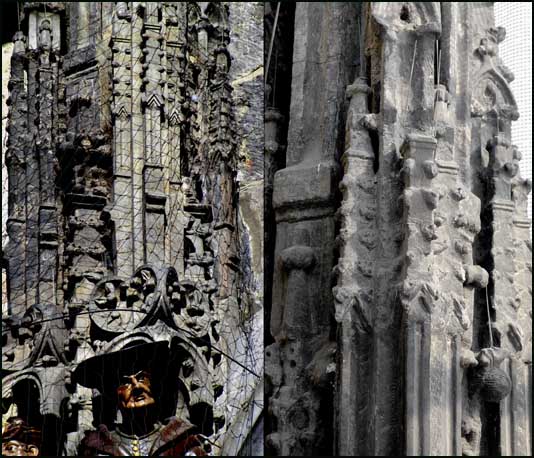
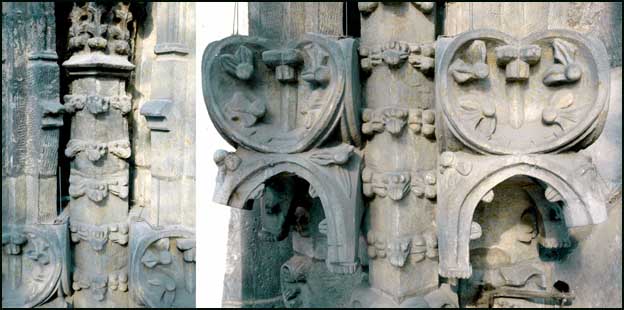
The three levels of the clock have their own support system on the sides. It has mainly decorative function, as the entire clock leans against the tower wall. It reminds us of its creators, builders of Gothic cathedrals.
|
 |
 |
 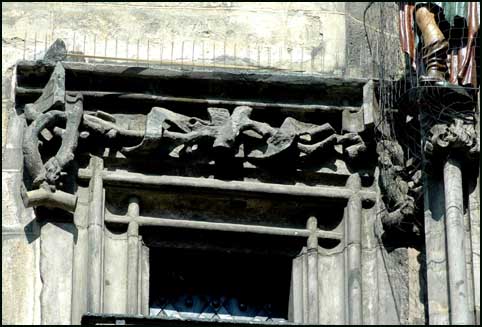 |
An apparently different creative approach to the decoration supports the theory that the astronomical clock was built in two Gothic stages: the area of the astrolabe was built before 1410 in Parléř-Gothic style and the area around the calendarium in Late Gothic style around 1490. For more details, see the chapters on history.
|
 |
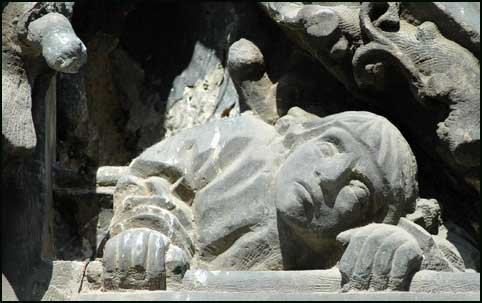
The calendarium (visually the entire astronomical clock) is supported by two figures of medieval stonemasons. Their clothes indicate their different social positions; they might be a craftsman and a journeyman. However, they would not have been able to build a cathedral without each other’s help. They are distinct sculptures, they are the lowermost sculptures on the clock and are thus best visible. They might be stylized creators of the clock; although they are called sleepers, they do not have their eyes closed when observed closely. They are not alone, although their expressions are unconcerned as though they were not interested in anything around. In a dark cavity on the western side, never penetrated by the sunlight, there is a sculpture of an owl. In the Middle Ages, an owl was a symbol of night but also of wisdom and reason. The meaning of this symbol is returning at the present time, e. g. at universities. The Middle Ages considered owls to be a symbol of remaining in the dark and infidelity.
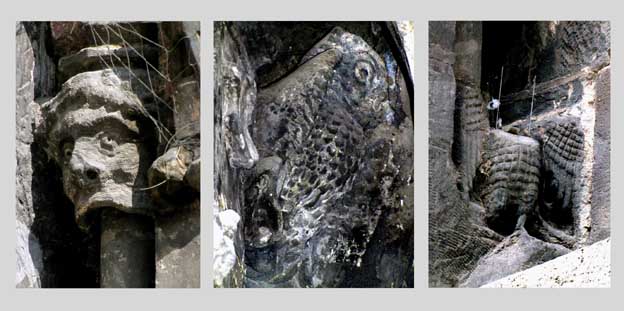
On the narrow side wall of this mystical building, there are two
small sculptures; they are the only sculptures at such a separated
position. They seem to be connected with the resting stonemasons. There
is a bird waking up, today headless, on the eastern side, and a dumb
face, a face without a mouth, on the western side. They are silent
witnesses of the fifteenth century, the time we call the Middle Ages
today. How will be our era called after a few centuries?
